Understanding Balance of Payments from Scratch: (II) Analysis of Hong Kong’s Current Account
When you review your finances at the end of the month, do you find money left over after deducting expenses from income? If so, it means you have a surplus, and you have money to save or invest. But if your expenses exceed your income, you run a deficit, and perhaps you need to draw on savings or borrow from others.
Just as personal finance records reflect your income and expenses, the Current Account in the Balance of Payments (BoP) captures an economy’s income and expenses from day-to-day economic transactions with the rest of the world. Building on our previous article about the basic introduction to the BoP, this time we will dive deeper into the components and economic significance of Hong Kong’s Current Account.
What makes up the Current Account?
The Current Account records trade in goods and services between “residents” and “non-residents”, as well as various types of fund flows. Think of the Current Account as a ledger of a company: it mainly records the income earned from selling goods and providing services abroad, plus other income from overseas investments, minus the expenses spent on importing goods and services, and other expenses paid abroad.
Specifically, the Current Account consists of the following four main components:
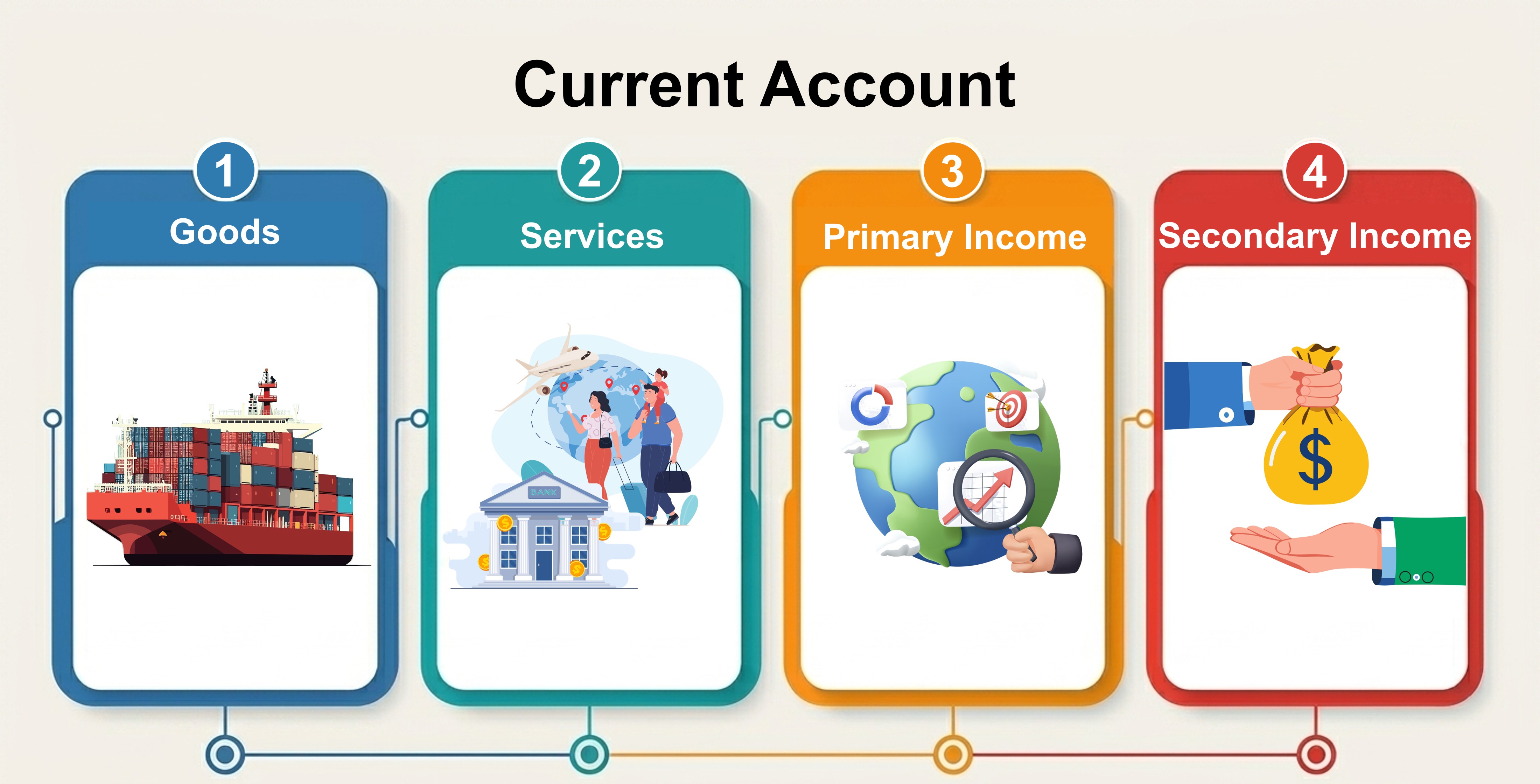
- Goods: imports and exports of physical products
For example: Hong Kong exports locally made electronic products to Europe (a credit item in the Current Account); or imports fresh fruit from Thailand to supply the local market (debit). Given the small scale of Hong Kong’s agricultural and manufacturing sectors, supply of local consumer goods relies heavily on imports. Consequently, Hong Kong usually runs a deficit in the Goods Account.
- Services: non-physical trades covering a wide range of economic activities
When tourists (“non-residents”) visit Hong Kong and spend on accommodation and transport, the income received by the hotels and transport operators (“residents”) are recorded as our exports of services (credit). Conversely, if Hong Kong residents buy flight tickets from overseas airlines to travel abroad, the expenses are imports of services (debit). In addition, as a global financial centre, Hong Kong attracts numerous overseas individuals and organisations to use our financial services (such as securities transaction, asset management, investment advisory, etc.), thereby generating a substantial surplus in the Services Account.
- Primary Income: income generated from cross-border work or investments
For example: dividends received by Hong Kong residents from overseas stock investments are fund inflows (credit), while salaries paid by Hong Kong organisations to non-residents working in Hong Kong on a short-term basis are fund outflows (debit). Having a huge stock of net external assets, Hong Kong records a surplus in the Primary Income Account consistently.
- Secondary Income: current transfers without an exchange of equivalent economic value
International donations to Hong Kong charities are fund inflows (credit), while foreign domestic helpers working in Hong Kong and sending money back home are fund outflows (debit). Similar to other developed economies, Hong Kong tends to donate and remit abroad, so our Secondary Income Account usually records a small deficit.
Surplus vs. deficit: what do they mean?
By adding up the four components above, we can determine whether an economy’s Current Account is in surplus or deficit:
-
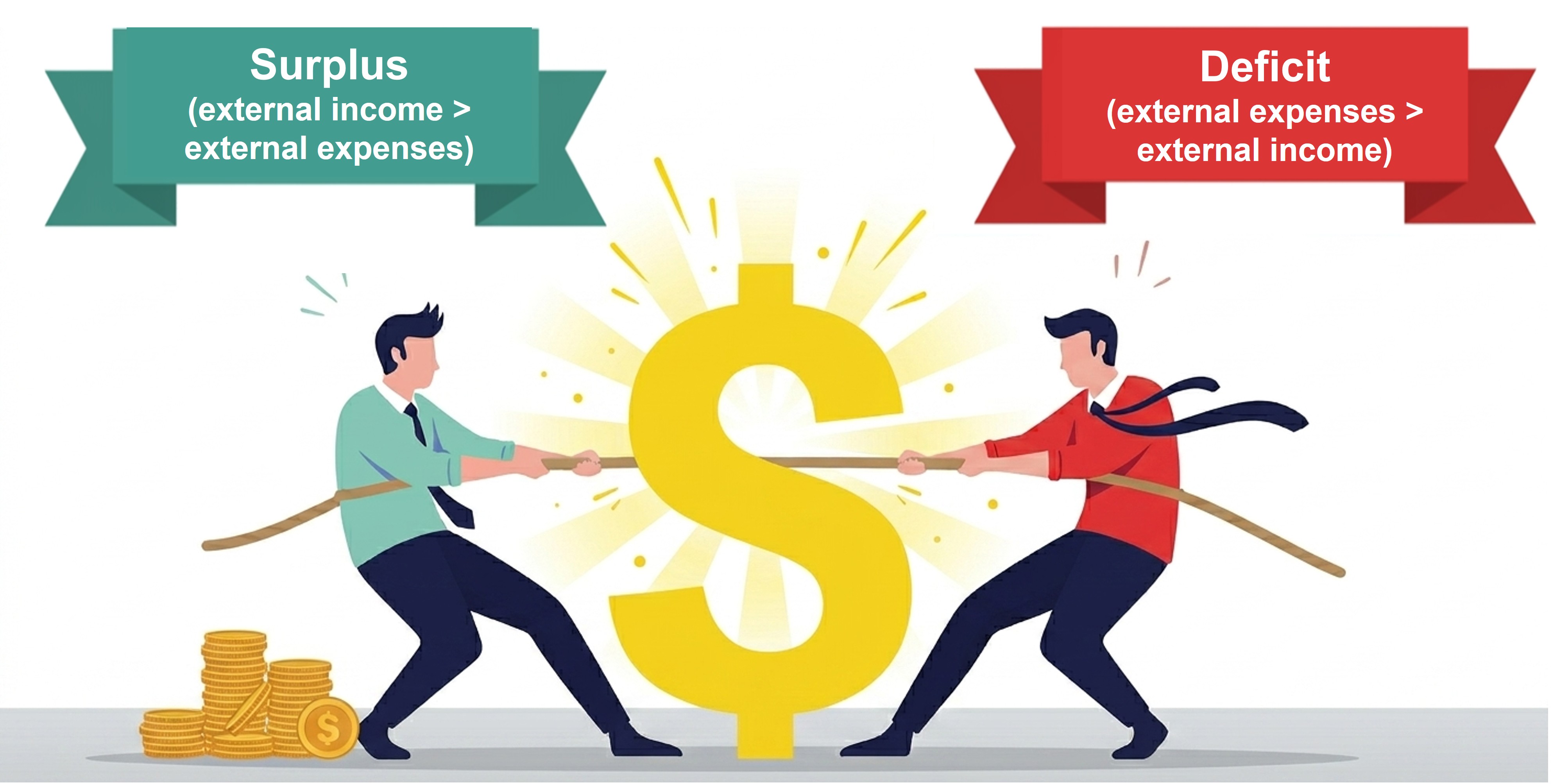
Current Account surplus = “net savings”
This means that external income exceeds external expenses — like having leftover pocket money after deducting all living expenses from your monthly income. It means the economy earns more from the rest of the world than it spends. As mentioned in the previous article, under the “double entries” principle of the BoP, this Current Account surplus is simultaneously reflected in the Financial Account as a capital outflow. For example, while exports of goods and services are recorded in the Current Account and contributed to the surplus, the foreign currencies earned through the transactions, or the foreign bonds or stocks bought using the money, will accumulate into the external assets of the economy, which are recorded in the Financial Account. (We will discuss the Financial Account in subsequent articles in this series.)
-
Current Account deficit = “net expenditures”
This means external expenses exceeds external income — like overspending. The economy may need to draw on savings (which effectively decumulates its external assets); or cover the gap by incurring external debt or attracting foreign investments. Under the “double entries” principle of the BoP, this is simultaneously recorded in the Financial Account as a capital inflow. A Current Account deficit is not necessarily bad. For example, if money is borrowed for investments and the future returns exceed the interest costs, it is generally considered favourable. However, if the deficit persists, one may need to be aware of potential economic risks.
Hong Kong’s Current Account landscape
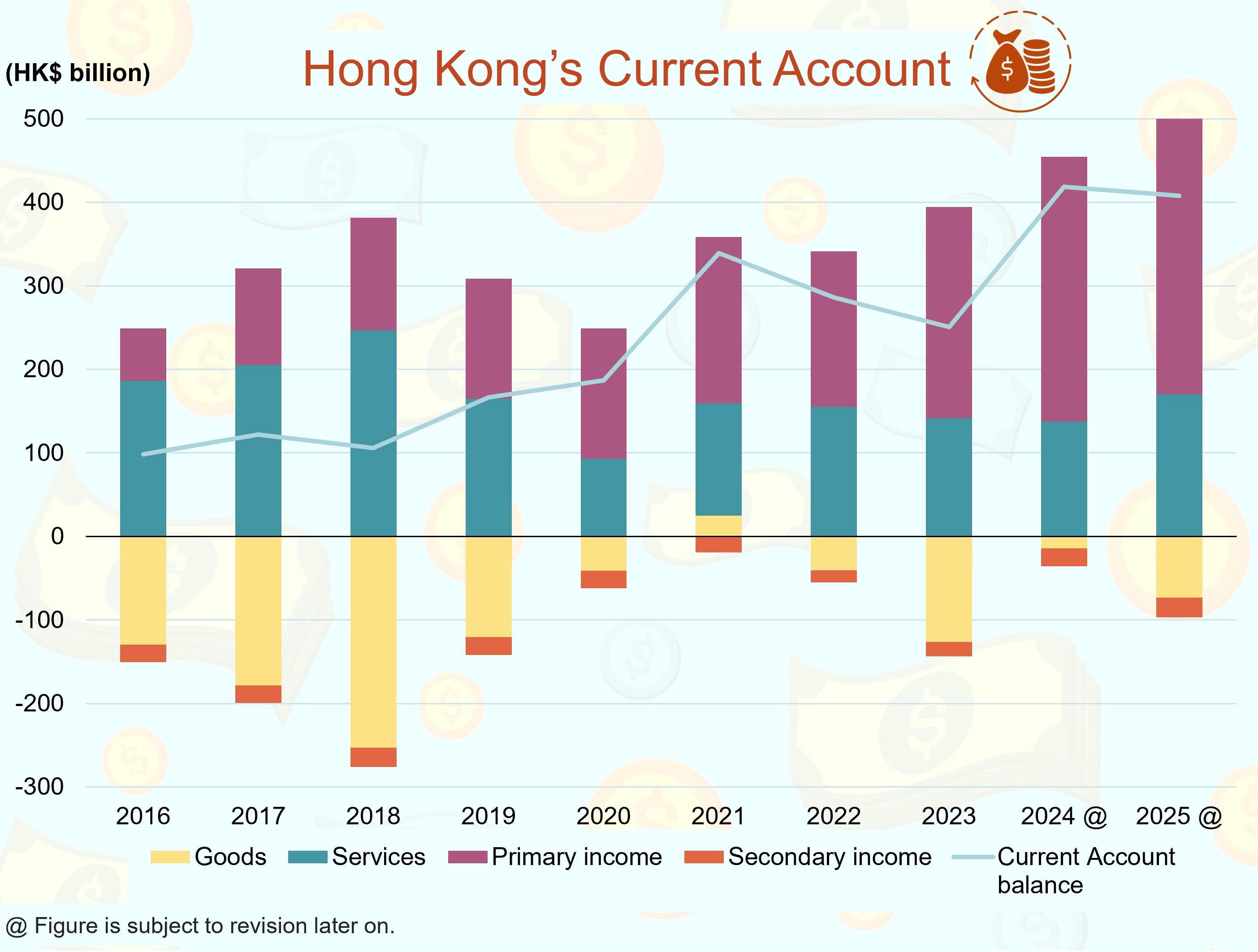
Hong Kong has maintained a robust Current Account surplus over the past decade, reflecting our role as a trade and finance gateway. From 2016 through 2025, the annual surplus showed consistent resilience, reaching a new milestone of over HK$400 billion in both 2024 and 2025 and reinforcing the economy's solid external position throughout the period. This strength was mainly attributed to Hong Kong’s large accumulated external assets and rising interest rates in recent years, which have generated substantial returns on overseas investments and driven strong growth in primary income. This helps consolidate Hong Kong’s position as a global financial centre.
How does Hong Kong compare globally?
To compare the Current Account performance of different economies, the Current Account balance as a percentage of Gross Domestic Product (GDP) is generally adopted as the assessment indicator. The chart below shows the performance of the Current Account for selected economies in 2024:
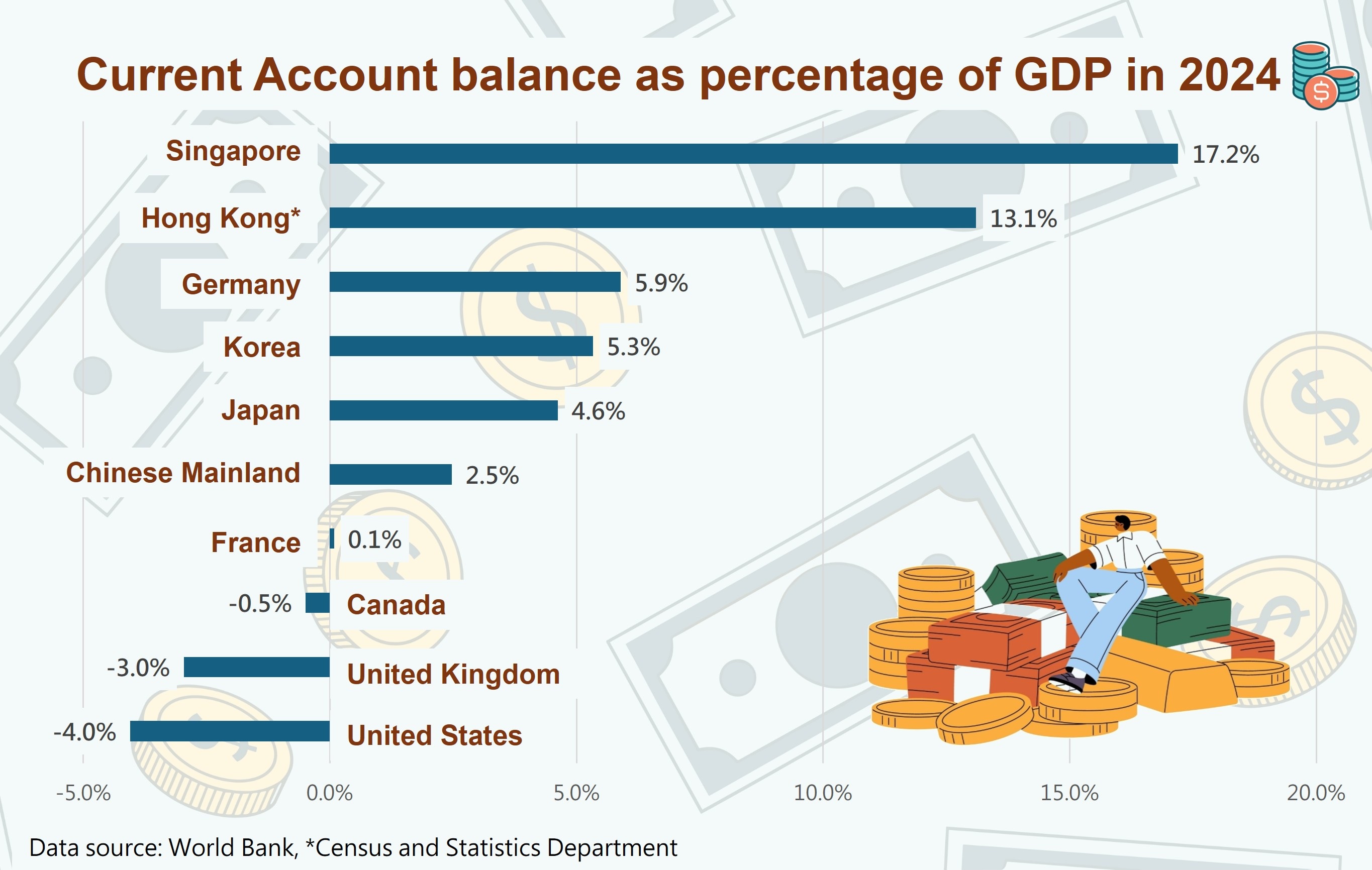
The differences as shown in the above chart reflect the operational models of different economies. Generally, export-oriented economies such as Germany and Chinese Mainland often post surpluses, while consumer-driven economies like the United States and the United Kingdom tend to show deficits. Hong Kong’s competitive edge stems from our open, services export-driven economic model and sizable stock of external assets. These structural factors enable Hong Kong to sustain substantial surpluses in the Current Account amid global uncertainty.
Understanding the Current Account is not just about looking at a set of numbers; it is about understanding how Hong Kong thrives in an interconnected world.
In subsequent articles in this series, we will explore the Capital Account, Financial Account and other BoP-related concepts.
For more information, please visit the webpage on “Balance of Payments”.
WONG Kam-hung, Wilson
Statistician
15 July 2026