Understanding Balance of Payments from Scratch:
(I) The Secrets of Balance of Payments
(I) The Secrets of Balance of Payments

Do you keep track of your personal budget? If so, congratulations – you understand its powerful role in financial management! Budgeting helps you understand your income and expenses, which is fundamental to effective financial management. Similarly, Hong Kong maintains a comprehensive and professional accounting system to track its economic transactions. This ledger has a resounding name – "Balance of Payments"!
What is the Balance of Payments (BoP)?
Your personal ledger records all transactions of income and expenses conducted between you and other individuals, stores, financial institutions, etc. Similar to the perspective of individuals, from the viewpoint of a whole economy, Hong Kong engages in countless transactions with other economies in the world every day: importing fresh durians from Thailand, exporting Hong Kong-made watches worldwide, foreign enterprises setting up offices here, local hotels accommodating foreign tourists, and our residents travelling abroad for leisure, etc. These diverse cross-border transactions between Hong Kong "residents" and "non-residents" are neatly tracked in a professional ledger – Hong Kong's BoP.
How should Hong Kong "residents" be defined?
To understand the BoP, we must first grasp the distinction between Hong Kong "residents" and "non-residents".
In the context of the BoP, the term "residents" actually encompasses not only individuals but also organisations. To determine the "resident" status for both individuals and organisations, it depends on their centre of predominant economic interest. Specifically,
- For individuals: "Hong Kong residents" refer to those who normally stay in Hong Kong, irrespective of their nationality. As a more specific statistical criterion, "normally stay" means having already stayed or intend to stay for at least 12 months.
- For organisations: "Hong Kong residents" refer to those which ordinarily operate in Hong Kong.
The Three Major Accounts of BoP: Where does money come from, and where does it go?
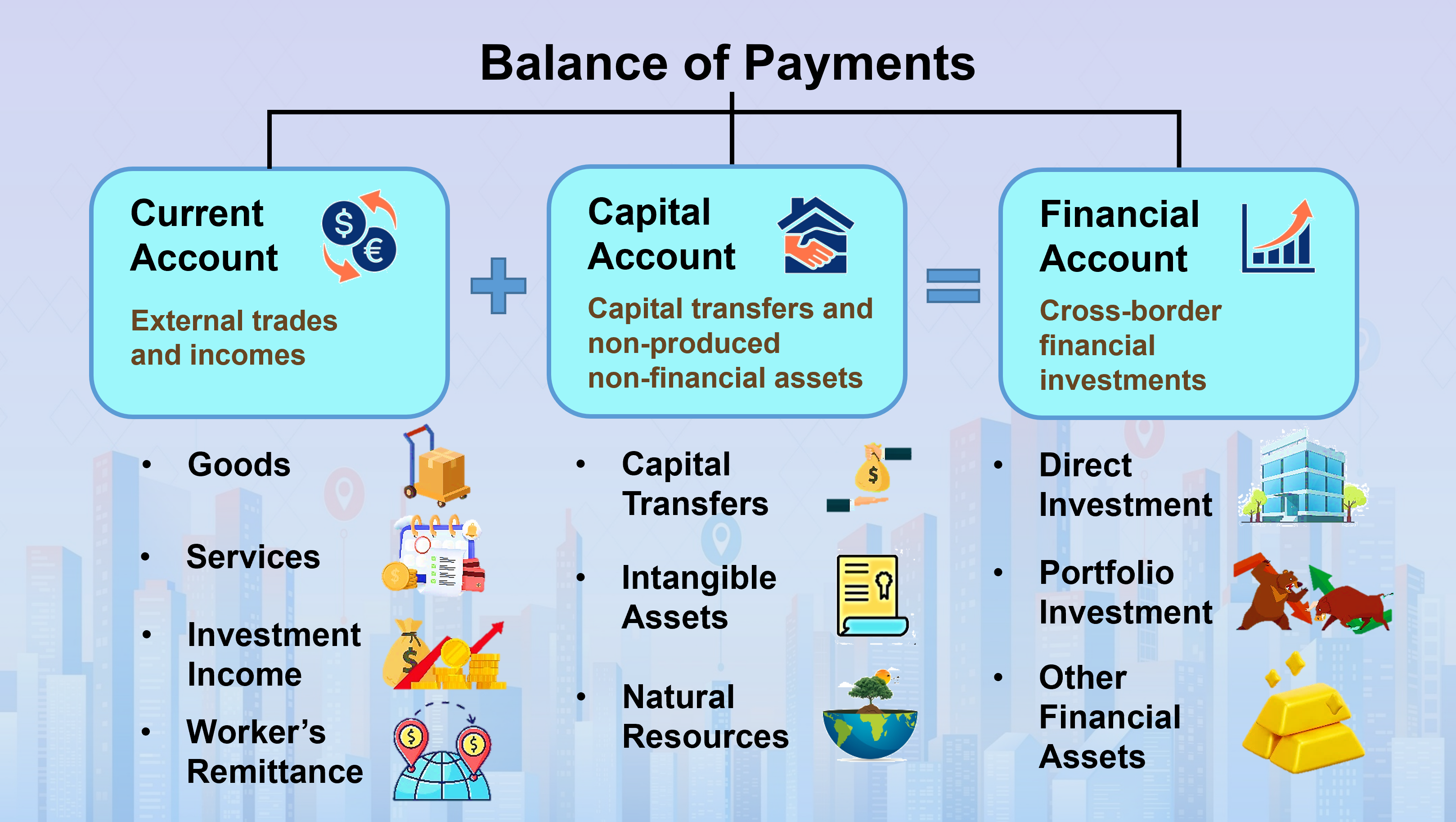
Just as you might categorise your personal finance into areas like "salary", "living expenses", and "investments", the BoP organises Hong Kong's cross-border fund flows into three main accounts:
- Current Account: records trade in goods and services, and income flows
- Capital Account: records capital transfers and transactions involving non-produced, non-financial assets
- Financial Account: tracks financial investment flows
The Secret of "Balance" – Double-entry Accounting System
You might wonder: why is it called the "Balance" of Payments? Does it mean that Hong Kong's international transactions always balance out? In fact, the term "Balance" refers to the accounting equilibrium achieved by the sum of the Current Account and Capital Account versus Financial Account. The secret lies in the fact that every transaction generates "double entries"!
Similar to the way in which "increased income" is recorded in personal finance and usually corresponds to "more cash", the BoP also adopts a double-entry bookkeeping approach, recording every transaction with two entries: a credit and a debit. For example, suppose a Hong Kong company exports toys to an overseas company and receives payment in foreign currency, this transaction will be recorded in Hong Kong's ledger respectively in:
- Current Account: Hong Kong's income increases from selling goods abroad (Credit – exports of goods).
- Financial Account: Increase in Hong Kong's foreign currency deposits due to receiving payment in foreign currency from an overseas buyer (Debit – increases in Hong Kong's external assets).
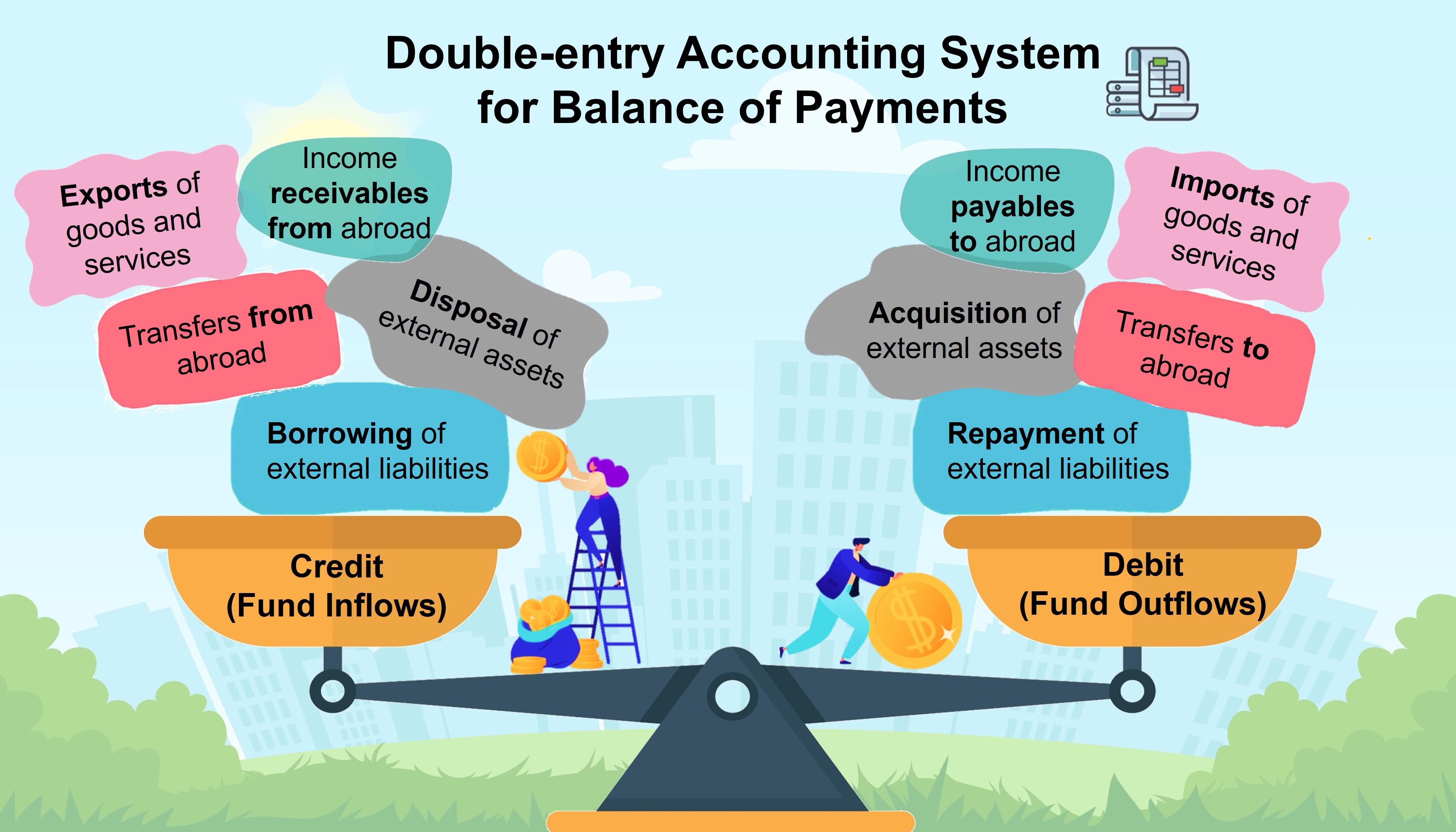
This "every debit has a corresponding credit" recording approach ensures that the ledger is always balanced, much like the two sides of a scale. This is why it's called the "Balance of Payments"!
In the next article in this series, we will further examine the concept of Current Account along with its key implications.
For more information, please visit the subject webpage on "Balance of Payments".
LUK Kin-fung, Harry
Statistician
30 October 2025