Decoding Consumption Indicators: Private Consumption Expenditure
In the previous article of this series, we followed the daily lives of the Wong family to understand how Gross Domestic Product (GDP) is calculated and how its various expenditure components piece together to shape the overall economic picture. Today, we will focus on one of the expenditure components most closely related to us — Private Consumption Expenditure.
What is Private Consumption Expenditure?
Private Consumption Expenditure (PCE) measures the total expenditure of Hong Kong residents on goods and services for personal use, regardless of whether the expenditure is made within or outside Hong Kong.
Take the Wong family as an example: in addition to monthly household expenditure such as rental payments, groceries, dining out, and transport expenses, their spending on overseas trips is also included in PCE. As a major expenditure component of GDP, changes in PCE effectively reflect the consumption sentiment of Hong Kong residents under different economic conditions.

A thirty-year journey: the rise and fall of the consumption wheel
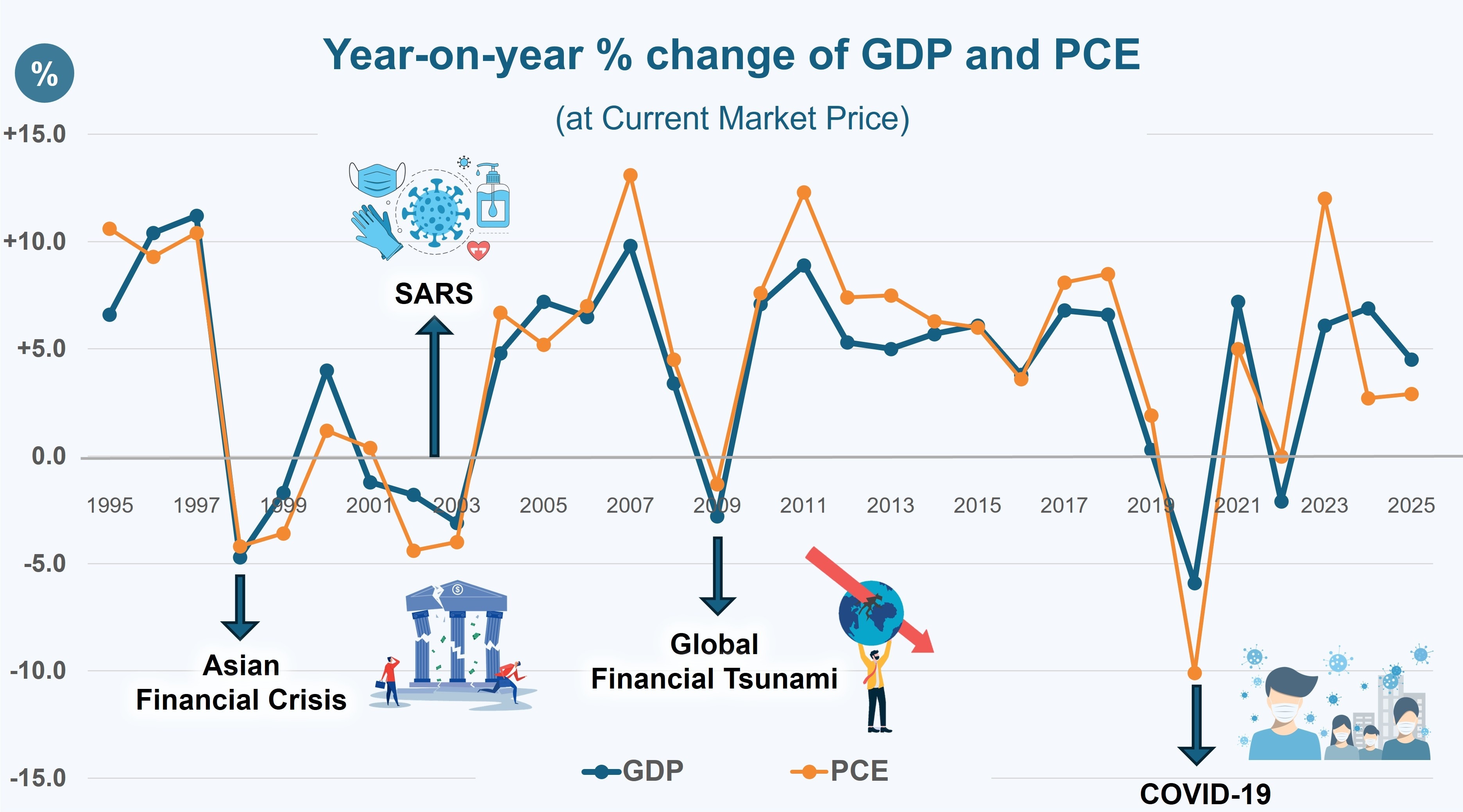
Looking back over the past three decades, Hong Kong’s consumption growth has experienced multiple ups and downs. At current market prices, PCE reached HK$2,206 billion in 2025, more than tripling from HK$696 billion in 1995, representing an average annual growth rate of about 3.9%.
In boom years, such as 1997 and 2007, the consumption intent of Hong Kong residents rose significantly as supported by a robust job market, driving PCE to record over 10% growth in these two years; while the growth of GDP at current market prices reached 11.2% and 9.8% respectively over the same period. These data show that PCE moves in tandem with GDP, with the two closely tracking each other.
However, this upward trajectory was not without challenges. During the 1998 Asian Financial Crisis, the 2003 SARS outbreak, and the 2008 – 2009 Global Financial Tsunami, the Hong Kong economy was significantly impacted. During the difficult periods, many families had cut their spending, resulting in PCE contractions during those periods.
The greatest shock to Hong Kong’s economy in recent years was the COVID-19 pandemic. In 2020, GDP plunged by 5.9%, while PCE fell even more sharply by 10.1% — the steepest decline in the past three decades. During that time, the Wong family’s lifestyle changed drastically: Lily switched to attend online classes at home, and Mr and Mrs Wong worked from home most of the time. Staying indoors led to a sharp drop in the family's spending such as that on transport and dining out, while their planned family trip was inevitably canceled.
Fortunately, these difficult periods were temporary. Hong Kong’s economy has demonstrated strong resilience, often recovering quickly once crises passed.
The "great wheel" of PCE has fluctuated with the economic environment, but it serves as a true record of the life trajectories of Hong Kong residents over the years – from the daily details of the Wong family or the spending trade-offs made by every citizen in response to changing times.
To learn more
For the latest PCE figures and more detailed information, please visit the subject webpage on “National Accounts”.
CHEN Chen
Research Manager
21 May 2026