A Hong Kong Family’s Story: Understanding GDP through a Daily Life Example
"The Hong Kong economy expanded by 3.8% year-on-year in the fourth quarter of last year, and grew by 3.5% for the whole year."
You may often see headlines like this in the news. But do you know how an economy’s economic performance is measured and how it connects to our daily life?
What is Gross Domestic Product?
The economic performance of an economy can be measured by Gross Domestic Product (GDP). Hong Kong’s GDP refers to the total value of goods and services produced by all producing units (including individuals and organisations) ordinarily operating in Hong Kong over a specified period. GDP can be compiled in different ways, among which the “expenditure approach” and “production approach” are the two most common methods. Today, let’s look at the “expenditure approach”, which ties closely to our daily life.
In simple terms, GDP compiled by the “expenditure approach” only includes the value of goods and services for final use, and excludes the value of goods and services consumed in the production process to avoid double counting. Furthermore, since imported goods and services are not produced locally, their value is deducted from the total value of goods and services for final use to reflect the economic contribution of domestic production. Here is the core formula of the “expenditure approach”:
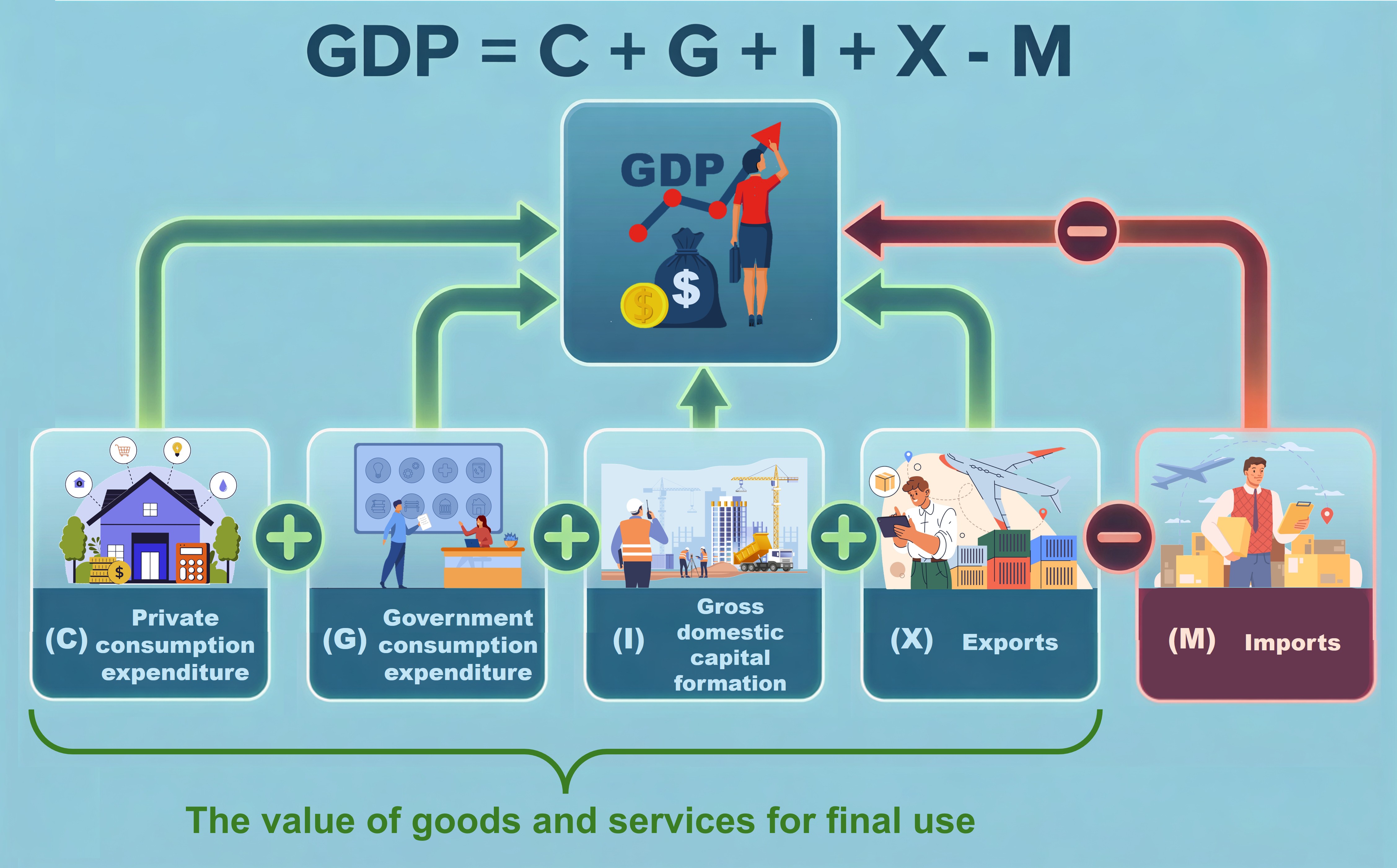
To make it easier to understand, let’s meet the Wong family — Mr Wong, Mrs Wong, and their daughter Lily — and see how their daily routines contribute to these components of GDP.
Private consumption adds momentum
The story begins on Sunday. The Wong family starts the morning at a Cantonese restaurant to enjoy tea and dim sum, and then goes to the cinema to see a new movie. These everyday expenses are typical examples of private consumption expenditure (C) in GDP. In fact, households’ expenditures on goods and services, from public transport and personal care services to clothing, food, household necessities and so on, fall under private consumption expenditure. This component not only reflects our daily consumption patterns, but also serves as a key engine driving many economic activities (such as retail, catering and personal services activities).
Government spending serves the community
On Monday, Lily attends her government school as usual. After class, she borrows books from a public library, and then rents recreational facilities at a nearby sports centre. These kinds of services are delivered by government departments not engaged in commercial activities. The expenditures on employing staff as well as purchasing goods and services to maintain these services fall under government consumption expenditure (G) in GDP.
Capital investment embraces the future
On Tuesday, Mr Wong, who is an employee of a tech company, orders the latest model of desktop computers and some other equipment from Chinese Mainland for the office, while his colleague assists in developing new-generation computer software and carrying out research and development (R&D) work. After work, Mr Wong notices that a large shopping centre is under construction near his residential estate. The construction expenditure on the shopping centre, and his company’s expenditures on purchasing the computers and other equipment as well as developing new computer software and conducting R&D, are classified as gross domestic capital formation (I) in GDP, representing the investment that can enhance production capacity.
External trade connects the world
On Wednesday, Mrs Wong, who is an employee of an import and export trading company, oversees the re-export of a batch of electronic products from Hong Kong to Vietnam. At the same time, she also provides trade advisory services to a client from Korea. Hong Kong’s sales of goods and services to other economies belong to the part of exports (X) in GDP.
On Thursday, Mrs Wong hosts a friend from Europe, who spends on a hotel stay, dinner and souvenirs in Hong Kong. Providing goods and services to inbound visitors is also considered as sales of goods and services to other economies, so all of her friend’s spending in Hong Kong is counted under the component exports (X).
However, each of the above expenditure components (C, G, I and X) may contain some imported goods or services. For example, the new computers purchased by Mr Wong’s company in (I) are imported and are apparently not the result of local production. Therefore, when calculating GDP, the total value of imports (M) is deducted as a whole to derive the total value of goods and services produced in Hong Kong.
Real growth reflects the actual economic situation
The GDP growth rate reported in the news generally refers to the growth rate in real terms, which excludes the effect of price changes. It can more truly reflect the economic growth from producing more goods and services.
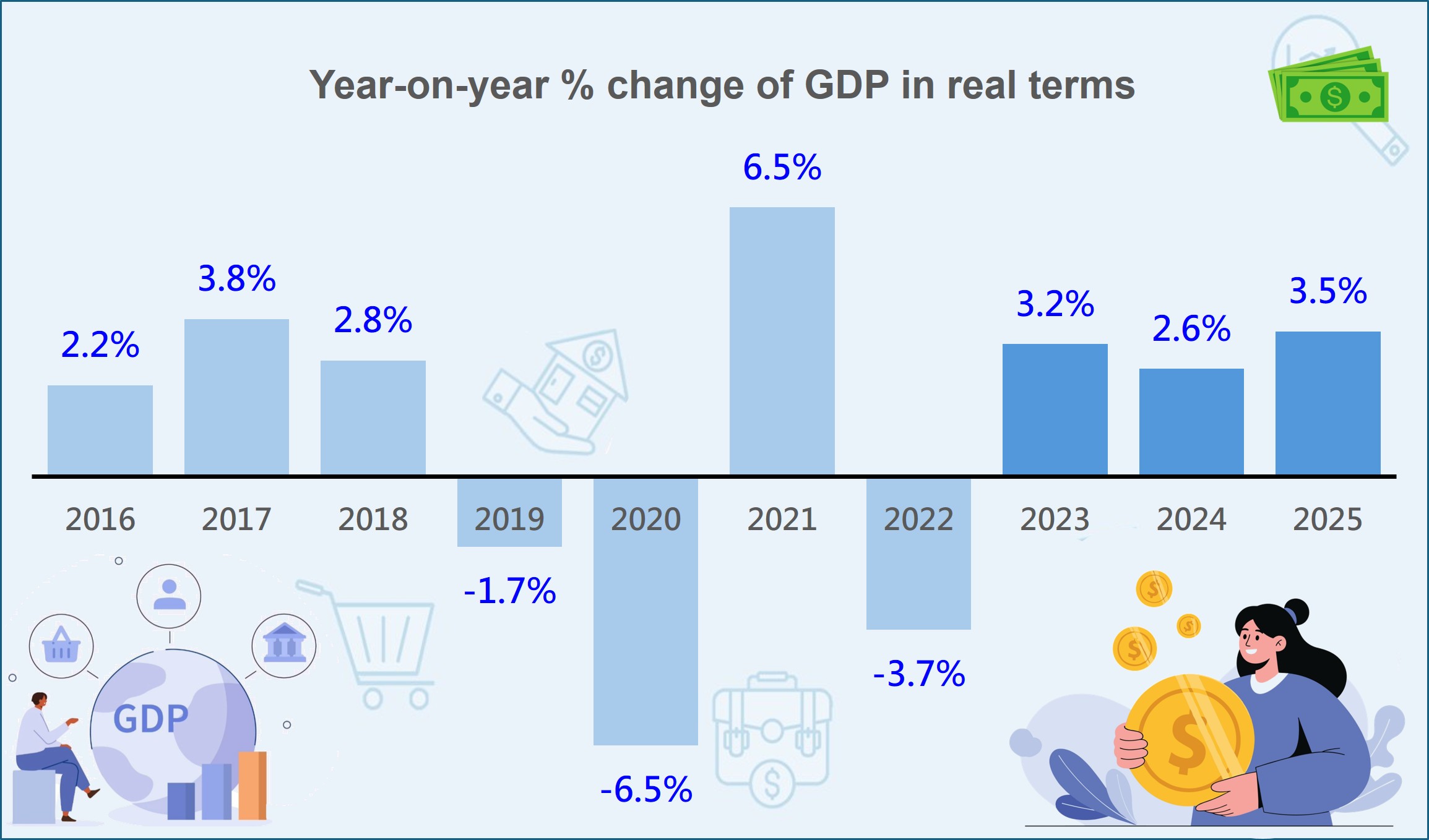
According to the latest figures released in February 2026, Hong Kong’s GDP in 2025 rose by 3.5% in real terms over 2024, marking the third consecutive year of expansion since the resumption of normalcy.
Building prosperity together
GDP is an important economic indicator, and the economic growth is the result of joint efforts of countless families and institutions. Next time we engage with the economic activities nearby, let’s take a moment to consider the ways we are contributing to the local economy.
To learn more
In subsequent articles in this series, we will introduce another method for compiling GDP and other GDP-related concepts. For the latest figures and more detailed information of GDP, please visit the subject webpage on “National Accounts”.
KWOK Kai-yin, Sunny
Statistician
5 March 2026