Demystifying Private Housing Rental Index in the Consumer Price Index

The Consumer Price Index (CPI) is an important indicator of inflation. It measures the changes over time in the price level of consumer goods and services generally purchased by households. Compiling this index requires two types of information: the expenditure weights of households, i.e. the percentage shares of different consumer items in total household expenditure; and data on price changes of these consumer items. The larger the expenditure weight of an item, the greater the impact of its price changes on the CPI.
In Hong Kong, private housing rent accounts for over 30% of household expenditure on average, making it one of the major consumer items for many households. The Private Housing Rental Index is an important component of the CPI, and its changes have a considerable impact on the overall inflation level.
This article will introduce to you the Private Housing Rental Index compiled by the Census and Statistics Department (C&SD), explaining its coverage, the statistical concept of the “rental equivalence approach”, and the compilation method.
Covering all renter and owner-occupier households
The Private Housing Rental Index covers private housing renter households under all types of lettings in Hong Kong, whether they are new lettings, renewed lettings, or continued lettings that have already been in effect for some time, while the calculation of rent includes rates and government rent payments.
In addition, this index also covers owner-occupier households. Since owner-occupier households do not actually pay rent, why are they also included in the rental index?
Understanding the rental equivalence approach and its application
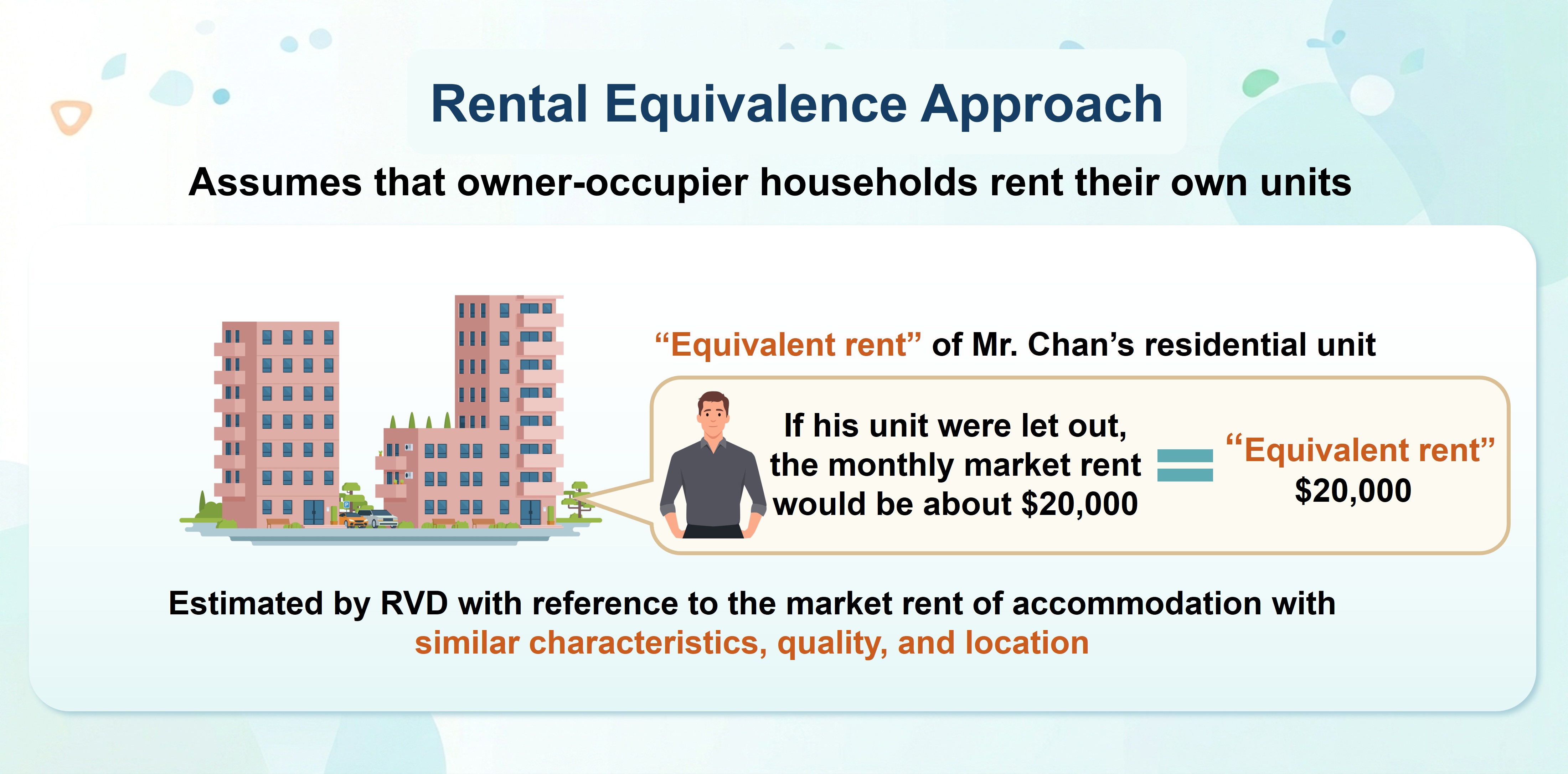
Under the concept of consumer prices, all households, regardless of whether renter or owner-occupier households, consume housing services. Therefore, for owner-occupier households, C&SD has adopted the internationally recommended and widely used rental equivalence approach in order to include them in the rental index. In simple terms, this method assumes that owner-occupier households rent their own units, and that the “equivalent rent” they “pay” is equal to the rent of comparable units in the market. For example, Mr. Chan lives in his own property. If his unit were let out, the monthly market rent would be about $20,000. This “equivalent rent” represents Mr. Chan’s housing expenditure. The “equivalent rent” adopted by C&SD is estimated by the Rating and Valuation Department (RVD) with reference to the market rent of accommodation with similar characteristics, quality and location.
Calculating the Private Housing Rental Index involves three steps
First, compiling the expenditure weights in the Private Housing Rental Index.
- C&SD calculates separately the respective shares of renter and owner-occupier households in the total monthly rent of all private housing households, which are used as the expenditure weights for calculating the index.
Second, calculating the monthly movements of the Private Housing Rental Index.
- For renter households, C&SD conducts a monthly sample survey to collect their rental data. Since floor area is a major factor affecting rent, C&SD first groups the data by floor area, and then calculates the rental movements based on the rental changes of each group.
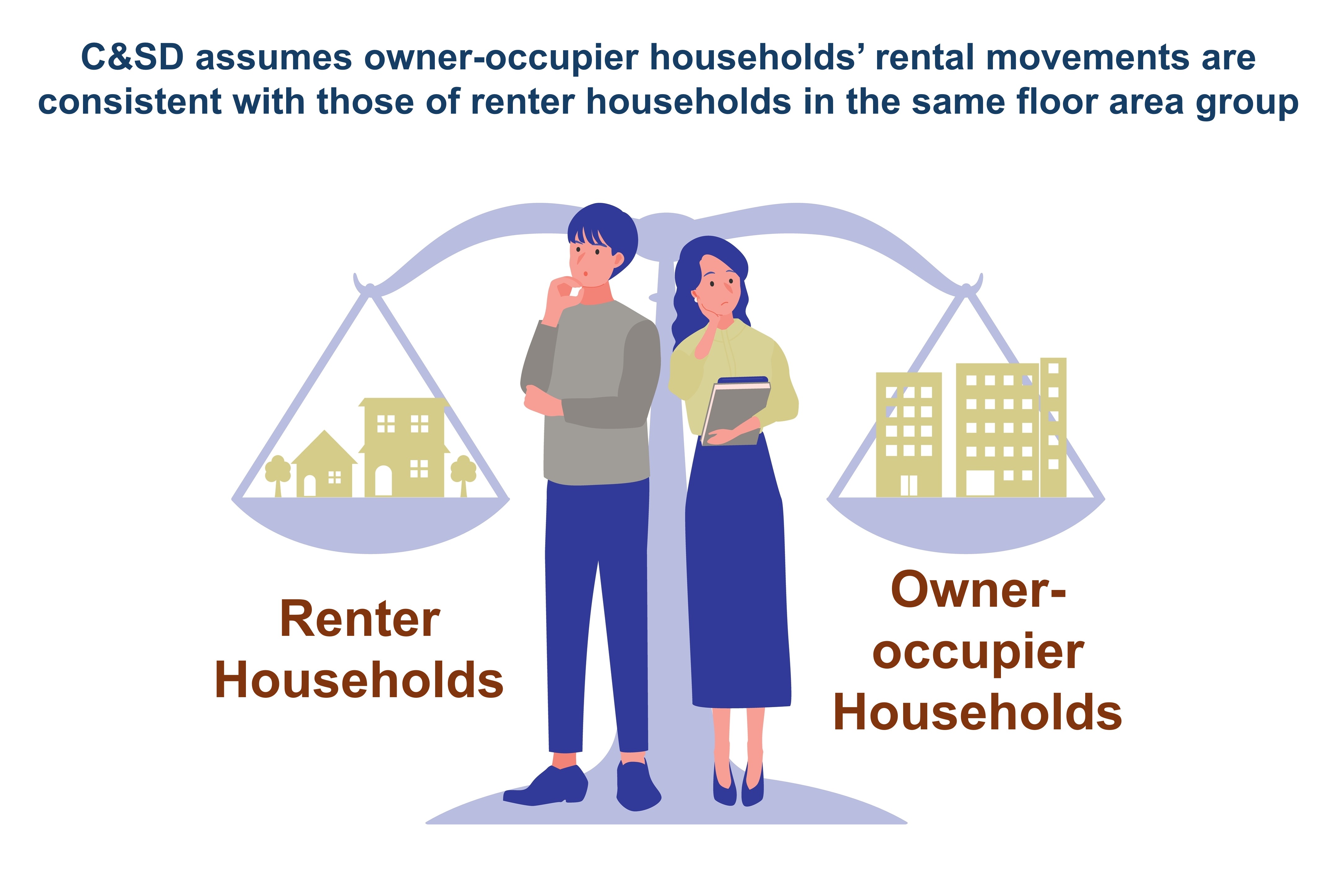
- For owner-occupier households, C&SD assumes their rental movements are consistent with those of renter households in the same floor area group. Therefore, C&SD applies the rental movement data of renter households collected from the monthly survey to owner-occupier households.
Third, weighted aggregating the above two types of information.
- With the above two types of information, C&SD aggregates the rental movements of renter and owner-occupier households using their respective expenditure weights to obtain the Private Housing Rental Index, so as to comprehensively reflect the rental movements of all private housing households.
Why does the movement of the Private Housing Rental Index usually not fluctuate significantly?
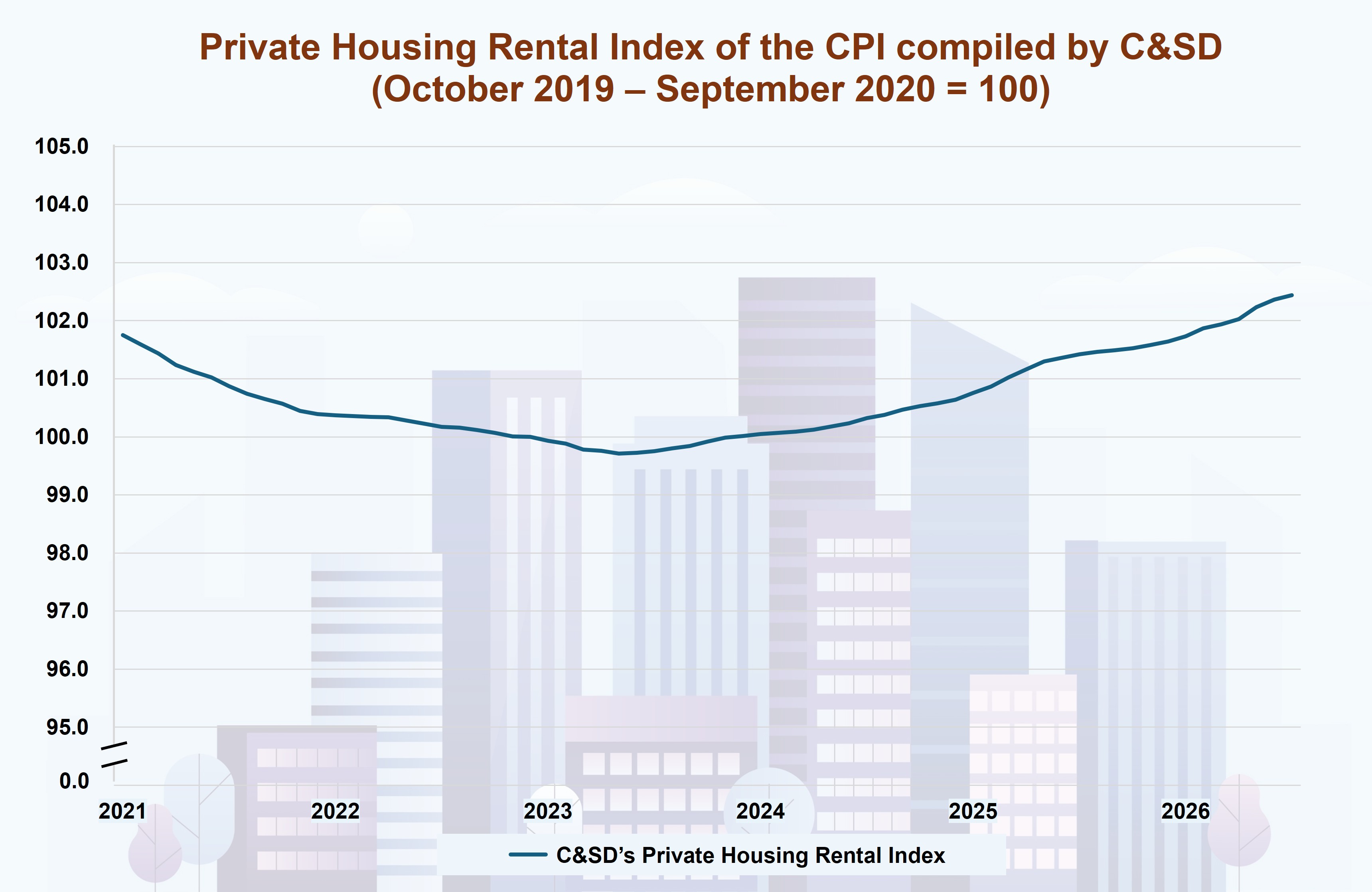
In Hong Kong, most private housing tenancy agreements run for two years, during which rent usually remains fixed for the first year. Even if the rent of new lettings in the market rises sharply, the rent of continued lettings often cannot be adjusted in the first year. Since the Private Housing Rental Index covers all types of lettings, and most of them are continued lettings that have not yet expired, the impact of rental movements of new lettings is diluted. Therefore, the index movement is usually stable and does not fluctuate significantly.
Summary
The Private Housing Rental Index is an important component of the CPI, reflecting the rental movements of private housing households as a whole. It covers renter households of all types of lettings, and through the rental equivalence approach also includes owner-occupier households in the calculation, thereby comprehensively reflecting the rental movements of all private housing.
For more details on the Private Housing Rental Index, please visit the “Consumer Prices” webpage.
CHAN Cheuk-wang, Alvis
Statistician
21 September 2026