Hong Kong's R&D Landscape

Research and Development (R&D) activities
The general public often associates R&D activities with the various academic research conducted in tertiary institutions and their affiliated research centres. In fact, R&D activities can be much closer than people might think. Higher education institutions aren’t the only ones allocating resources to R&D activities. The business sector also actively allocates resources in R&D activities, aiming to transform research outcomes into innovative products or commercial applications that enhance production efficiency and boost profitability.
Taking healthcare robotics as an example. Before its launch in the market for daily use, the businesses might collaborate with higher education institutions to perform R&D activities to develop necessary functions such as identifying and communicating with patients, detecting falls, and reminding patients to take their medicine. R&D activities are mainly "experimental" in nature, and research outcome is uncertain despite the investment of cost and manpower. Regardless of research outcome, the resources put in R&D activities are considered R&D expenditures.
If research progress is made, the research outcome will be subsequently applied in the "implementation" phase. For instance, this could involve the production of healthcare robotics, which would require additional resources. All expenditures incurred during the "experimental" R&D and "implementation" phases of commercial innovation are covered in the innovation activities statistics. We'll discuss more about this next time.
Today, let us take a look at the statistics of R&D activities.
R&D expenditure
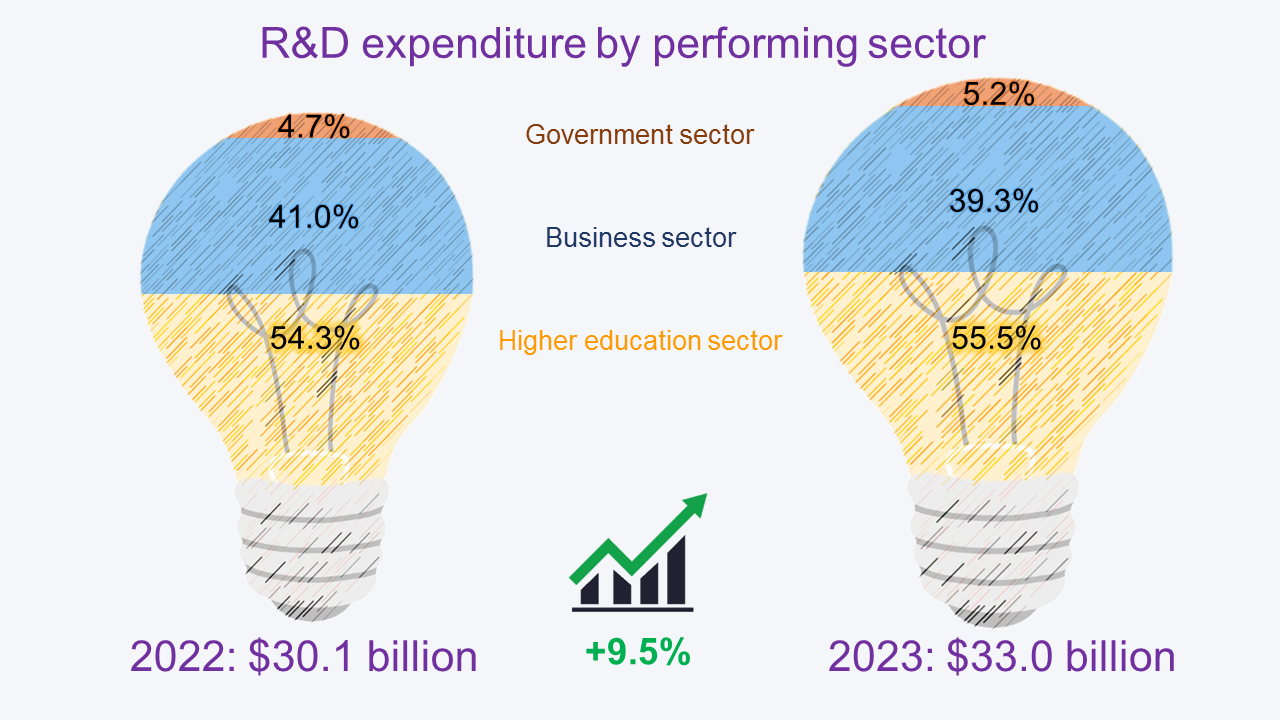
In 2023, the gross domestic expenditure on research and development (GERD) of Hong Kong amounted to $33 billion, representing an increase of 10% compared to 2022. Among such expenditure, 40% was related to the R&D activities performed in the business sector, second only to the higher education sector of 55%. The remaining 5% was related to the R&D activities performed by the government sector.
R&D personnel
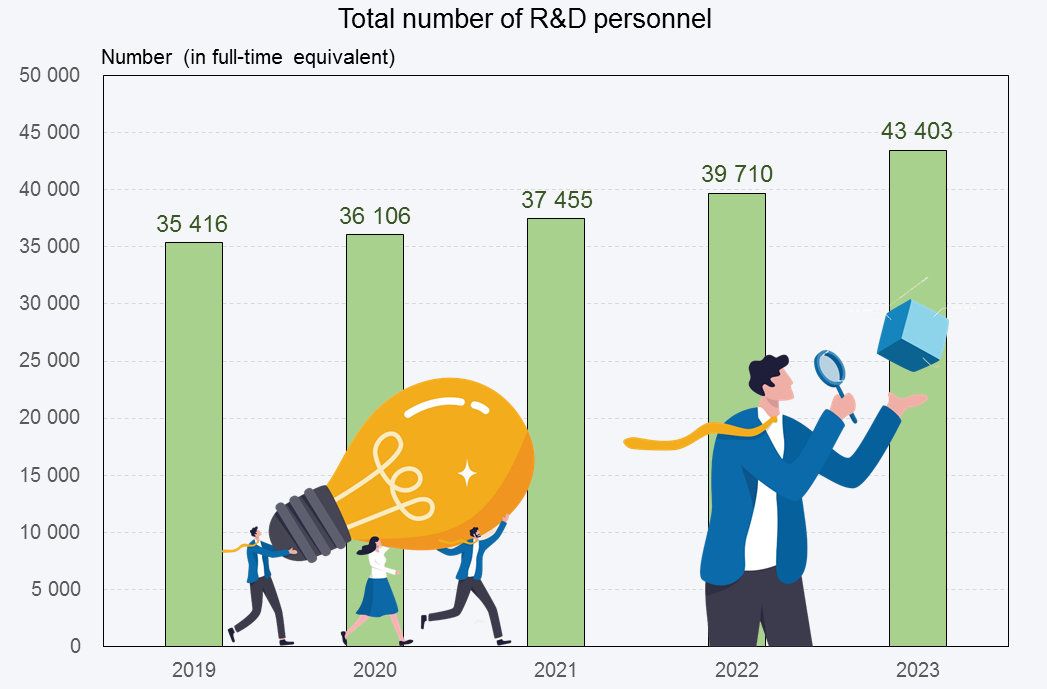
Amid the rapid advancement of technology, accelerated by the leaps in big data analytics and artificial intelligence, there is a growing demand for R&D and relevant talent in Hong Kong. In 2023, in terms of full-time equivalent, the total number of R&D personnel in Hong Kong exceeded 40 000, representing a 9% increase year-on-year. Among them, those in business sector accounted for 32%, just behind the 65% from higher education institutions.
R&D area of the business sector
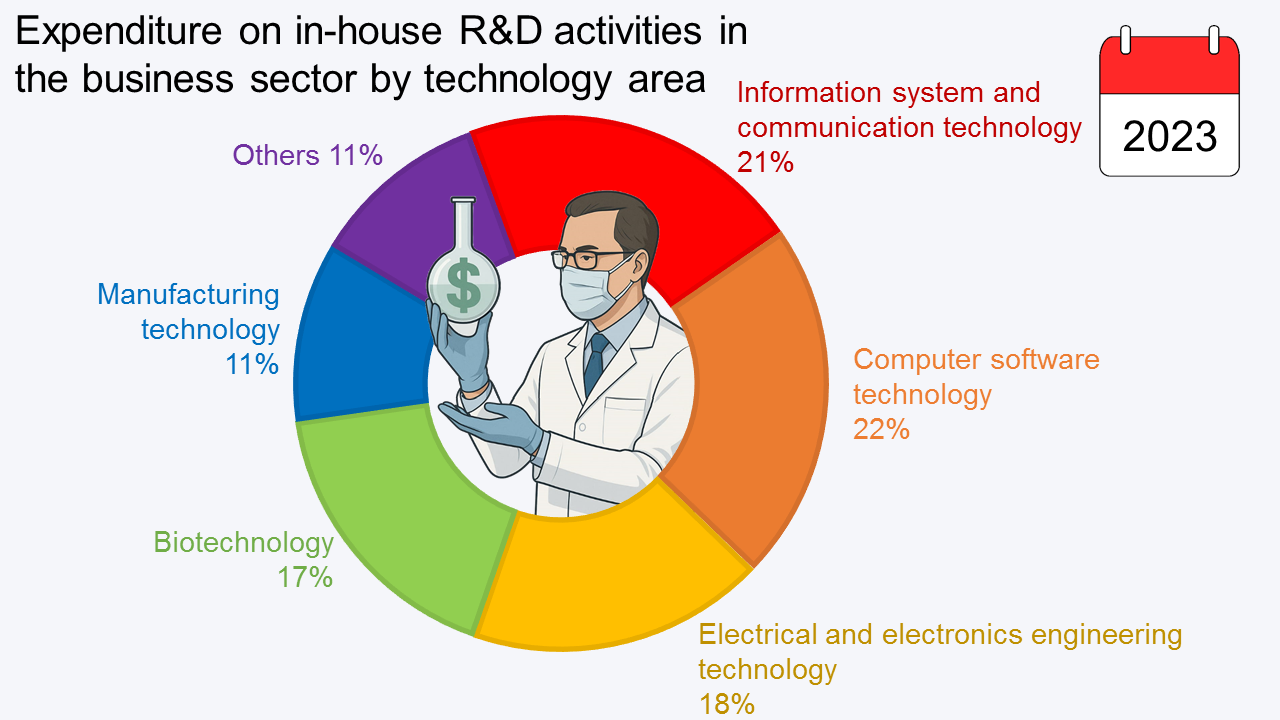
Hong Kong has a flourishing Information and Communications Technology (ICT) market with 5G coverage reaching over 90% of the population. Analysed by technology area, the expenditure on in-house R&D activities in information systems and communication technology has remained over 20% of the total of business sector for the past 5 years.
The R&D expenditure on biotechnology and manufacturing technology has also increased since the establishment of InnoHK research clusters. Their respective shares of total R&D expenditure amounted to 17% and 11% in 2023, up from 11% and 6% in 2019.
For more details on R&D statistics, please refer to "Hong Kong Innovation Activities Statistics – 2023 Edition" published by C&SD.
CHAN Kin-cheong, Taylor
Statistician
15 May 2025